
Substack Pricing
- Marketing pricing
- No published price
- Free plan
Substack pricing is recorded here from the vendor's own published plans. There is a free plan.
Substack publishes no standalone pricing page, so this opens the product site. Figures here were read on 9 August 2026.
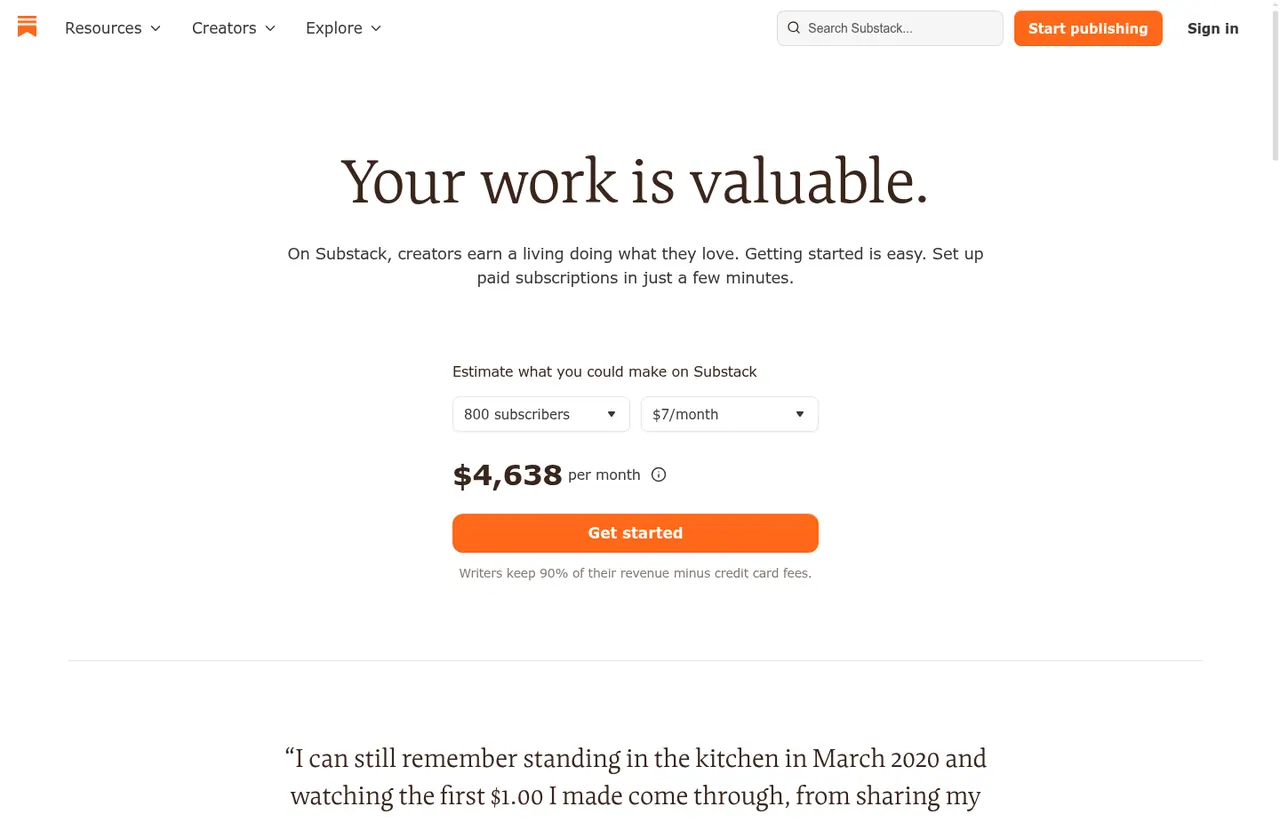
Substack pricing at a glance
| Entry price | Free to publish; Substack takes 10% of paid subscription revenue |
|---|---|
| Seat minimum | None on the entry plan |
| Free plan | Yes |
| Free trial | No trial offered |
| How it charges | usage based |
| Prices read from | The vendor's own pricing page |
| Last checked | 9 August 2026 |
Every Substack plan and what it costs
Read from the vendor's own pricing page on 9 August 2026. Charged as usage based. No free trial is offered.
| Plan | Price | Billing | What it is |
|---|---|---|---|
| Publishing | $0 | per month | Free to write, send and grow a free list, with no subscriber limit |
| Paid subscriptions | 10% | per usage | Writers keep 90% of revenue, before credit card processing fees |
| Payment processing Add-on | Additional | per usage | Card fees are deducted on top of the 10%, charged by Stripe |
Substack pricing against its competitors
Compared on the smallest invoice each vendor will accept, not on the advertised per-seat rate. Where a product has a seat minimum, the figure below is the minimum times the rate, because that is the cheque you would actually write.
| Product | Cheapest paid entry | Free plan | Against Substack |
|---|---|---|---|
| Kit | $33 a month | Yes | – |
| beehiiv | $43 a month | Yes | – |
| Substack | Not published | Yes | This product |
Which Substack plan should you buy?
| Your situation | Recommended | Why |
|---|---|---|
| You are starting and do not know if anyone will pay | Publishing, free | No subscriber cap and no cost. Paying 10% of nothing is better than paying $96 a month to discover nobody subscribes. |
| You have turned on paid subscriptions | Accept the 10% | Writers keep 90% before card fees. Reasonable while revenue is small, and it never stops scaling. |
| You earn a few thousand a month from subscriptions | Do the arithmetic against beehiiv | At $5,000 a month you pay Substack $500. beehiiv's Max plan is roughly $96 and takes nothing from subscriptions. |
| You need automation or segmentation | Do not use Substack | There is almost none. Kit or beehiiv if your publication is a funnel. |
| You want to leave later | You can, and lists export properly | Subscriber export works cleanly, which is the most important thing about any list tool. |
The fee, precisely
Publishing on Substack is free with no subscriber cap. If you turn on paid subscriptions, Substack’s own page states that writers keep 90% of their revenue minus credit card fees. So the deduction is two-part: Substack’s 10%, then payment processing on top, charged through Stripe rather than by Substack.
That wording matters when modelling income. Ten per cent is the number people quote, but the amount reaching your account is lower than 90% once card fees are taken.
Where 10% stops being a bargain
The revenue share is what makes Substack risk-free to start and expensive to succeed on. Some rough arithmetic at a $5 monthly subscription:
| Paying subscribers | Monthly revenue | Substack’s 10% |
|---|---|---|
| 100 | $500 | $50 |
| 1,000 | $5,000 | $500 |
| 5,000 | $25,000 | $2,500 |
At the top of that table you are paying $30,000 a year. beehiiv would charge roughly $1,200 for its Max plan and take nothing from subscriptions. The crossover comes earlier than most writers expect, and the fee applies to every renewal indefinitely.
None of which makes starting elsewhere correct. Paying 10% of nothing is better than paying $96 a month to find out no one subscribes.
The network is the real differentiator
Recommendations, the app and Notes move readers between publications, and for many writers a large share of new subscribers arrive that way. No self-hosted tool can offer this, because it is not a feature but an audience. If discovery matters more to you than margin, that is the argument for staying.
What you give up
Design control is narrow by design, so Substacks look like Substacks. There is no serious automation: no behavioural sequences, no conditional segmentation, no lead scoring. There is no real API. If your publication is a business with a funnel rather than a body of writing, Kit or beehiiv will fit better.
Subscriber lists do export properly, which is the most important thing. Whatever you build here, you can take with you.
Substack questions, answered
- Does Substack have a free plan or free trial?
- Substack has a free plan. No free trial is offered.
- Can I self-host Substack?
- No. Substack is a hosted service only, so your data lives on the vendor's infrastructure.
Substack publishes no standalone pricing page, so this opens the product site. Figures here were read on 9 August 2026.
What this profile is based on
Nobody here has used Substack. This profile is desk research: prices read from the pages cited below, on the dates shown , from one primary source , with 2 captures taken by us . How we research a profile.
Where Substack appears on this site
- Another profile beehiiv names it as a competitor
Counts pages on this site that name the product by choice - price guides, pricing question pages, deal records and other profiles. Category and directory indexes list everything automatically and are not counted.
Provenance and freshness
What has changed
-
August 2026
- Confirmed the 90% writer share against Substack's own going-paid page
- Added plan picker and verdicts
Sources & verification
Facts on this page were read from the sources below on the dates shown. Where a vendor does not publish a figure, we record it as not disclosed rather than estimating it.
- Substack, going paid - checked 9 August 2026
Spotted something out of date? Email contact@everyany.one and we will re-check it. Corrections are logged on the page.