
Make Pricing
- Productivity pricing
- $9/mo at the smallest
- Free plan
Make pricing starts at $9 a month, which is $108 over twelve months. There is a free plan.
Opens the vendor's own pricing page. Figures here were read from it on 9 August 2026.
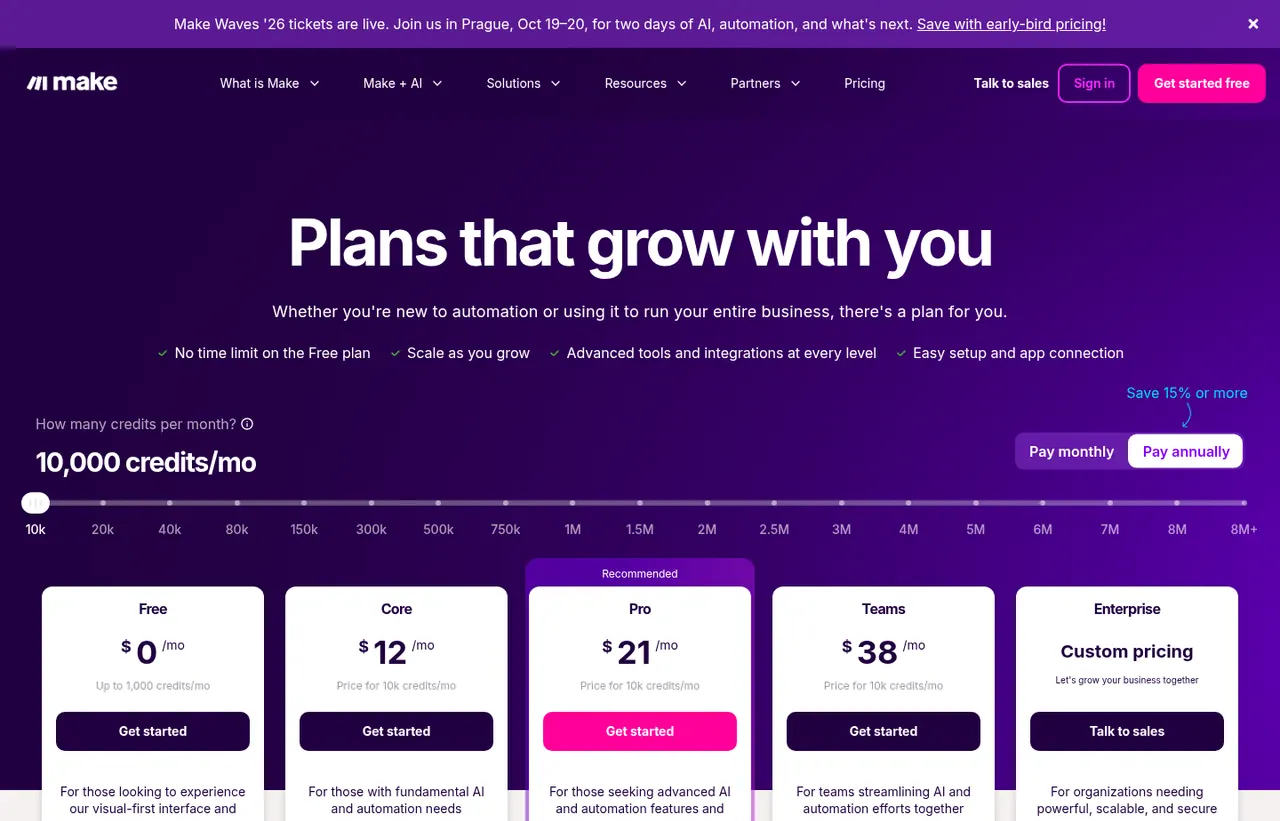
Make pricing at a glance
| Entry price | Free with 1,000 credits/month; Core $9/month at 10,000 credits, billed annually |
|---|---|
| Smallest invoice | $9 a month, or $108 a year |
| How that is reached | Core at $9 a month |
| Seat minimum | None on the entry plan |
| Free plan | Yes |
| Free trial | No trial offered |
| How it charges | usage based |
| Prices read from | The vendor's own pricing page |
| Last checked | 9 August 2026 |
Every Make plan and what it costs
Read from the vendor's own pricing page on 9 August 2026. Charged as usage based. No free trial is offered.
| Plan | Price | Billing | What it is |
|---|---|---|---|
| Free | $0 | per month | Up to 1,000 credits/month, 15-minute minimum interval between runs |
| Core | $9 | per month | Read from the credit slider at 10,000 credits/month, billed annually. Unlimited active scenarios |
| Pro | $16 | per month | Read from the credit slider at 10,000 credits/month, billed annually. Priority execution, custom variables |
| Teams | $29 | per month | Read from the credit slider at 10,000 credits/month, billed annually. Team roles and shared templates |
| Enterprise | Custom pricing | Negotiated | On-prem agent, overage protection, 24/7 support, advanced security |
What Make actually costs over a year
A monthly price is not the same thing as a monthly contract. These are the plans above resolved both ways, per seat or unit where the plan is charged that way. Where a vendor quotes only a yearly figure it is divided by twelve rather than left out, and the Quoted column says which figure the vendor actually publishes.
| Plan | Quoted | Monthly | Over 12 months |
|---|---|---|---|
| Core | per month | $9 | $108 |
| Pro | per month | $16 | $192 |
| Teams | per month | $29 | $348 |
Make pricing over time
Read from 21 archived captures of the vendor's pricing page , spanning February 2022 to September 2026. Every figure below links to the capture it came from, so you can check it against the page as it stood on the day.
- Core has been published at $9 in every capture we read, from 24 August 2022 to 4 September 2026.
- Pro has been published at $16 in every capture we read, from 24 August 2022 to 4 September 2026.
- Teams has been published at $29 in every capture we read, from 24 August 2022 to 4 September 2026.
Core
| Published price | Charged | Seen from | Last seen | Capture |
|---|---|---|---|---|
| $9 | Not stated | 24 August 2022 | 4 September 2026 | Archive |
Pro
| Published price | Charged | Seen from | Last seen | Capture |
|---|---|---|---|---|
| $16 | Not stated | 24 August 2022 | 4 September 2026 | Archive |
Teams
| Published price | Charged | Seen from | Last seen | Capture |
|---|---|---|---|---|
| $29 | Not stated | 24 August 2022 | 4 September 2026 | Archive |
3 archived captures with no price we could read
The capture exists, but the figures on it could not be extracted - usually a page that renders prices in JavaScript, or a currency selector the archive did not record. Listed rather than dropped, because a gap in a price history reads as "nothing changed" and these are not that.
Compiled 18 September 2026 from the Internet Archive Wayback Machine. Plan names were matched against the archived page text and the first currency-anchored figure within 160 characters was recorded, rejecting any figure with a competing plan name standing between it and the name it was matched to. The currency and the unit were read from each capture rather than assumed: captures served in a currency other than $, and captures where no plan name sat beside a figure, are listed as unread rather than dropped. Archived pages show the price as served to the archive's crawler, which may differ by region from the price you are shown.
Make pricing against its competitors
Compared on the smallest invoice each vendor will accept, not on the advertised per-seat rate. Where a product has a seat minimum, the figure below is the minimum times the rate, because that is the cheque you would actually write.
| Product | Cheapest paid entry | Free plan | Against Make |
|---|---|---|---|
| Make | $9 a month | Yes | This product |
| Zapier | $19.99 a month | Yes | +$10.99 a month (+122%) |
Which Make plan should you buy?
| Your situation | Recommended | Why |
|---|---|---|
| You are learning automation and can wait between runs | Free | 1,000 credits a month, but throttled to a 15-minute minimum interval. That limit, not the credits, is what forces the upgrade. |
| You need scheduling down to the minute | Core | $9 a month at 10,000 credits billed annually, with unlimited active scenarios. |
| You need priority execution and full-text log search | Pro | $16 a month at the same credit tier. |
| Several people build automations together | Teams | $29 a month at the same credit tier, adding roles and shared templates. |
| Your volume is high | Set the credit slider before comparing | Every price is quoted at 10,000 credits and the slider runs past eight million. "Make starts at $9" is nearly meaningless alone. |
| You need one simple two-app automation | Consider Zapier instead | Zapier gets that done in two minutes with a gentler interface. |
Read the credit slider before you read the price
Make’s pricing page has a slider labelled “How many credits per month?” that runs from 10,000 to more than eight million. Every plan price moves with it. The figures quoted everywhere, including here, are the prices at 10,000 credits a month with annual billing: Core $9, Pro $16, Teams $29. Monthly billing costs more, since the page describes annual as saving 15% or more.
So “Make starts at $9” is true and close to meaningless on its own. Estimate your monthly credit consumption first, set the slider to it, and compare the resulting number against Zapier. At low volume the two are similar; at high volume Make usually wins by a wide margin, because Zapier charges per task while Make charges per credit and a credit goes further.
Data transfer scales with the same dial: roughly 5 GB per 10,000 monthly credits.
Routers are the actual product
A Zapier Zap is fundamentally a sequence. A Make scenario is a graph. Routers split execution down several conditional paths, iterators loop over arrays, aggregators collapse results back into one bundle, and error handlers give a failed module somewhere to go other than a dead stop.
If your automation has an “if this, otherwise that, unless the record already exists” shape, this is the difference between a tool that fits and a tool you fight.
The free plan is real but throttled
1,000 credits a month, no time limit, roughly 3,000 apps, routers and filters included. The constraint is a 15-minute minimum interval between runs, so anything needing near-real-time reaction requires Core, where scheduling goes down to the minute. That single limit, not the credit allowance, is what usually forces the upgrade.
Where Zapier is still the right answer
Simple, linear, two-app automations. Zapier has more integrations, a gentler interface and gets a “when a form is submitted, add a row” job done in two minutes. Make rewards the time you invest in learning it, which is only a good trade if your workflows justify it.
Who owns it
Make is part of Celonis, a process-mining company, having been acquired as Integromat in 2020 and renamed in 2022. The product has continued to develop under that ownership rather than stagnating, which is worth saying because acquisition often goes the other way. It does mean the roadmap serves an enterprise process-intelligence strategy, not only the small teams who made Integromat popular.
Make questions, answered
- Does Make have a free plan or free trial?
- Make has a free plan. No free trial is offered.
- Can I self-host Make?
- No. Make is a hosted service only, so your data lives on the vendor's infrastructure.
Opens the vendor's own pricing page. Figures here were read from it on 9 August 2026.
What this profile is based on
Nobody here has used Make. This profile is desk research: prices read from the pages cited below, on the dates shown , from one primary source , with a capture taken by us . How we research a profile.
Where Make appears on this site
- Another profile Zapier names it as a competitor
Counts pages on this site that name the product by choice - price guides, pricing question pages, deal records and other profiles. Category and directory indexes list everything automatically and are not counted.
Provenance and freshness
What has changed
-
August 2026
- Pricing verified at the 10,000-credit tier with annual billing
- Added plan picker and verdicts
Sources & verification
Facts on this page were read from the sources below on the dates shown. Where a vendor does not publish a figure, we record it as not disclosed rather than estimating it.
- Make pricing - checked 9 August 2026
Spotted something out of date? Email contact@everyany.one and we will re-check it. Corrections are logged on the page.