
Clay Pricing
- Sales pricing
- $167/mo at the smallest
- Free plan
Clay pricing starts at $167 a month, which is $2,004 over twelve months. There is a free plan, and a trial on the paid tiers: 14 days.
Opens the vendor's own pricing page. Figures here were read from it on 9 August 2026.
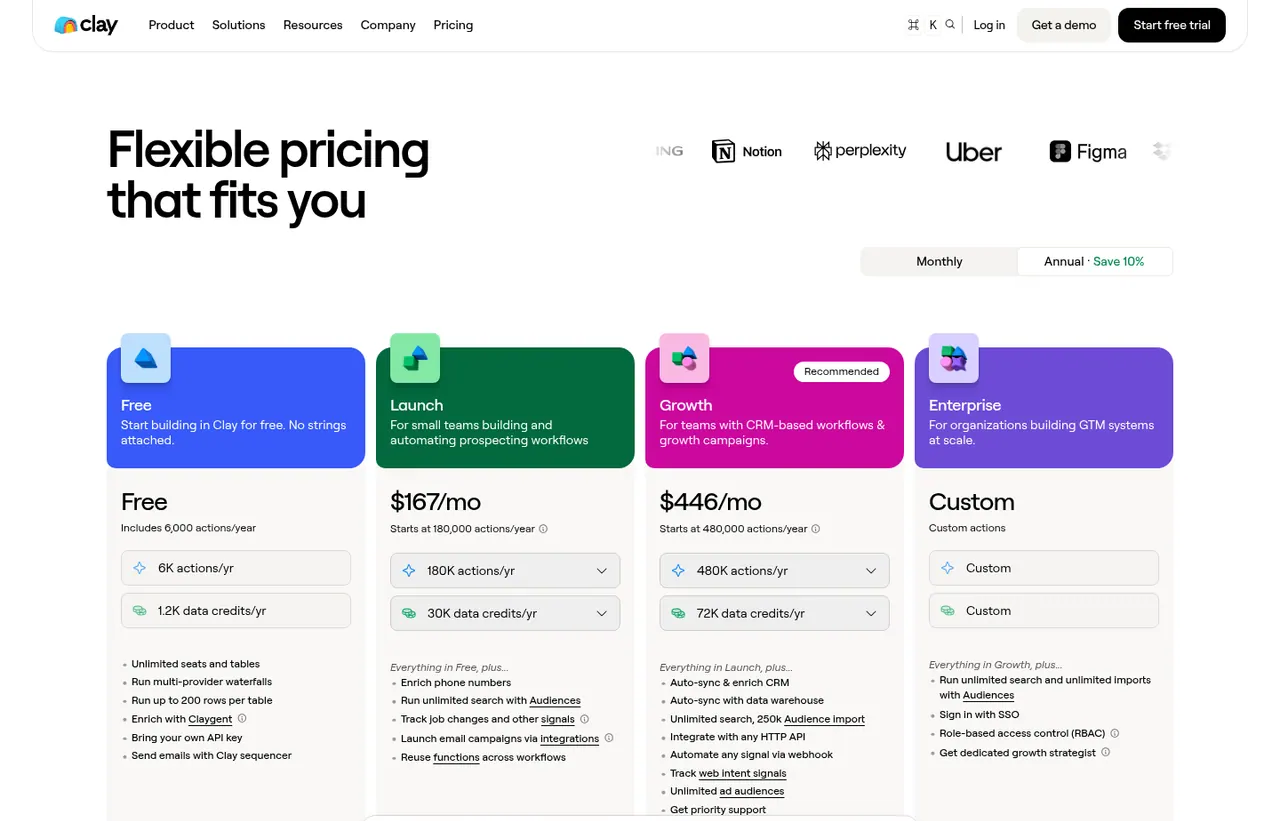
Clay pricing at a glance
| Entry price | Free with 100 data credits/month; Launch $167/month |
|---|---|
| Smallest invoice | $167 a month, or $2,004 a year |
| How that is reached | Launch at $167 a month |
| Seat minimum | None on the entry plan |
| Free plan | Yes |
| Free trial | 14 days |
| How it charges | usage based |
| Prices read from | The vendor's own pricing page |
| Last checked | 9 August 2026 |
Every Clay plan and what it costs
Read from the vendor's own pricing page on 9 August 2026. Charged as usage based. Free trial: 14 days.
| Plan | Price | Billing | What it is |
|---|---|---|---|
| Free | $0 | per month | 100 data credits/month, 1.2K a year. Unlimited seats and tables |
| Launch | $167 | per month | 30K data credits per year at the entry credit tier |
| Growth | $446 | per month | 72K data credits per year at the entry credit tier |
| Enterprise | Contact sales | Negotiated | Custom credit volumes, security review and support |
What Clay actually costs over a year
A monthly price is not the same thing as a monthly contract. These are the plans above resolved both ways, per seat or unit where the plan is charged that way. Where a vendor quotes only a yearly figure it is divided by twelve rather than left out, and the Quoted column says which figure the vendor actually publishes.
| Plan | Quoted | Monthly | Over 12 months |
|---|---|---|---|
| Launch | per month | $167 | $2,004 |
| Growth | per month | $446 | $5,352 |
Cancelling Clay, and getting money back
Read from the published Clay terms on 18 September 2026. These are the terms, not legal advice: consumer law where you live may give you rights the terms do not mention.
| When you cancel | Cancel from the Billing section at any time. The plan's features continue until the next payment date, at which point the account moves to the free plan. |
|---|
Clay FAQ, how can I cancel my plan ↗ · read 18 September 2026
Clay pricing over time
Read from 10 archived captures of the vendor's pricing page , spanning June 2022 to September 2026. Every figure below links to the capture it came from, so you can check it against the page as it stood on the day.
- Growth has been published at $446 in every capture we read, from 19 May 2026 to 3 September 2026.
- Launch has been published at $167 in every capture we read, from 19 May 2026 to 3 September 2026.
Growth
| Published price | Charged | Seen from | Last seen | Capture |
|---|---|---|---|---|
| $446 | Not stated | 19 May 2026 | 3 September 2026 | Archive |
Launch
| Published price | Charged | Seen from | Last seen | Capture |
|---|---|---|---|---|
| $167 | Not stated | 19 May 2026 | 3 September 2026 | Archive |
6 archived captures with no price we could read
The capture exists, but the figures on it could not be extracted - usually a page that renders prices in JavaScript, or a currency selector the archive did not record. Listed rather than dropped, because a gap in a price history reads as "nothing changed" and these are not that.
- 30 June 2022 - capture - no plan name sat next to a published figure in this capture
- 25 March 2023 - capture - no plan name sat next to a published figure in this capture
- 21 January 2024 - capture - no plan name sat next to a published figure in this capture
- 14 March 2025 - capture - no plan name sat next to a published figure in this capture
- 9 July 2025 - capture - no plan name sat next to a published figure in this capture
- 27 January 2026 - capture - no plan name sat next to a published figure in this capture
Compiled 18 September 2026 from the Internet Archive Wayback Machine. Plan names were matched against the archived page text and the first currency-anchored figure within 160 characters was recorded, rejecting any figure with a competing plan name standing between it and the name it was matched to. The currency and the unit were read from each capture rather than assumed: captures served in a currency other than $, and captures where no plan name sat beside a figure, are listed as unread rather than dropped. Archived pages show the price as served to the archive's crawler, which may differ by region from the price you are shown.
Clay pricing against its competitors
Compared on the smallest invoice each vendor will accept, not on the advertised per-seat rate. Where a product has a seat minimum, the figure below is the minimum times the rate, because that is the cheque you would actually write.
| Product | Cheapest paid entry | Free plan | Against Clay |
|---|---|---|---|
| Apollo.io | $49 a month | Yes | −$118 a month (−71%) |
| Clay | $167 a month | Yes | This product |
Which Clay plan should you buy?
| Your situation | Recommended | Why |
|---|---|---|
| You want to learn whether waterfall enrichment helps you | Free | 100 credits a month with unlimited seats. Enough to test on a small list. |
| You have a defined outbound motion and modest volume | Launch | $167 a month for 30K credits a year at the entry credit tier. |
| You enrich at scale across several signals | Growth | $446 a month for 72K credits a year, again at the entry tier. |
| Your volume is high | Set the credit selector before comparing | Every published price is the smallest credit tier. "Clay starts at $167" is true and nearly meaningless without your own volume. |
| You just need a searchable contact database | Consider Apollo.io instead | Cheaper, simpler, and sufficient if generic lists work for your market. |
Credits, not seats, and that cuts both ways
Clay gives every plan unlimited seats and unlimited tables, including the free one. You are billed for data credits, consumed when a row runs through an enrichment or research step.
| Plan | Price | Credits |
|---|---|---|
| Free | $0 | 100/month, 1.2K/year |
| Launch | $167/month | 30K/year |
| Growth | $446/month | 72K/year |
| Enterprise | Quote | Custom |
Those prices are the entry point of a credit selector that runs much higher, so “Clay starts at $167” is true only at the smallest paid volume. Set the credit level to your expected usage before comparing.
The upside of this model is real: a ten-person sales team costs the same as one person. The downside is that cost becomes a function of how carefully your tables are built, which is a skill your team may not have yet.
Credits burn on failure too
This is the thing to understand before committing. A waterfall that tries eight providers to find an email consumes credits at each attempt, whether or not it finds one. An AI research column runs on every row you point it at, including the 400 rows that were never good fits.
So a poorly targeted list of 5,000 companies with four enrichment columns can consume a month’s credits and return mostly blanks. The discipline that makes Clay cheap is filtering hard before enriching, not after.
Teams new to it should start with small batches and check credit consumption per useful record, not per row.
Waterfall enrichment is the actual innovation
Every data vendor has gaps. Ask Apollo for a mobile number and sometimes it has one. Clay’s answer is to ask Apollo, then a second provider, then a third, stopping at the first success.
The result is coverage no single vendor achieves, which matters because outbound is a coverage problem: a list where you can reach 70% of targets is worth far more than one where you can reach 40%. That is the argument for Clay over Apollo.io alone, and it is a good one.
When to buy Apollo instead
If what you need is a searchable database of contacts with reasonable data and a sequencing tool attached, Apollo is cheaper, simpler and sufficient. Clay is for teams whose targeting is specific enough that generic lists do not work, and who have someone willing to learn to build tables properly.
Without a defined outbound motion, Clay becomes an expensive way to research prospects you were never going to contact.
Clay questions, answered
- Does Clay have a free plan or free trial?
- Clay has a free plan. A free trial is available: 14 days.
- Can I self-host Clay?
- No. Clay is a hosted service only, so your data lives on the vendor's infrastructure.
Opens the vendor's own pricing page. Figures here were read from it on 9 August 2026.
What this profile is based on
Nobody here has used Clay. This profile is desk research: prices read from the pages cited below, on the dates shown , from one primary source , with 2 captures taken by us . How we research a profile.
Where Clay appears on this site
- Another profile Apollo.io names it as a competitor
Counts pages on this site that name the product by choice - price guides, pricing question pages, deal records and other profiles. Category and directory indexes list everything automatically and are not counted.
Provenance and freshness
What has changed
-
August 2026
- Credit tiers verified at the entry band for Launch and Growth
- Added plan picker and verdicts
Sources & verification
Facts on this page were read from the sources below on the dates shown. Where a vendor does not publish a figure, we record it as not disclosed rather than estimating it.
- Clay pricing - checked 9 August 2026
Spotted something out of date? Email contact@everyany.one and we will re-check it. Corrections are logged on the page.